
Plant protein your body can actually use — all nine essential amino acids, combined and calculated
Rice is short on lysine. Beans are short on methionine. Eat either alone and part of that protein is wasted. AminoAce searches 200+ ingredients for the combinations that cover each other's gaps — and works out the exact ratio that covers them best.
Free, no account, no sign-in. Closed testing while the stores review it.
01The problem
Nine amino acids you cannot make yourself
Protein is made of amino acids. Nine of them are essential amino acids — EAAs — meaning your body cannot produce them and has to get them from food. Whatever is in shortest supply caps how much of that protein your body can actually build with. You do not have to fix this at every meal — your body pools amino acids across the whole day — but over a day of eating, the gaps still have to be covered by something.
Almost no whole food carries all nine in the right proportions. The one in shortest supply relative to what you need is called the limiting amino acid, and it caps the value of everything else on the plate.
This matters most if you eat little or no meat. Animal proteins tend to be complete on their own, so an omnivore fixes almost any meal by adding an egg. Plant-based eating needs a little more intention — which is the entire reason this app exists.
White rice — 56% Kidney beans — 77% Combination WHO requirement
White rice 52% · Kidney beans 48% → 95%
02How it works
How it works
Three taps from a cupboard to a combination you can cook.
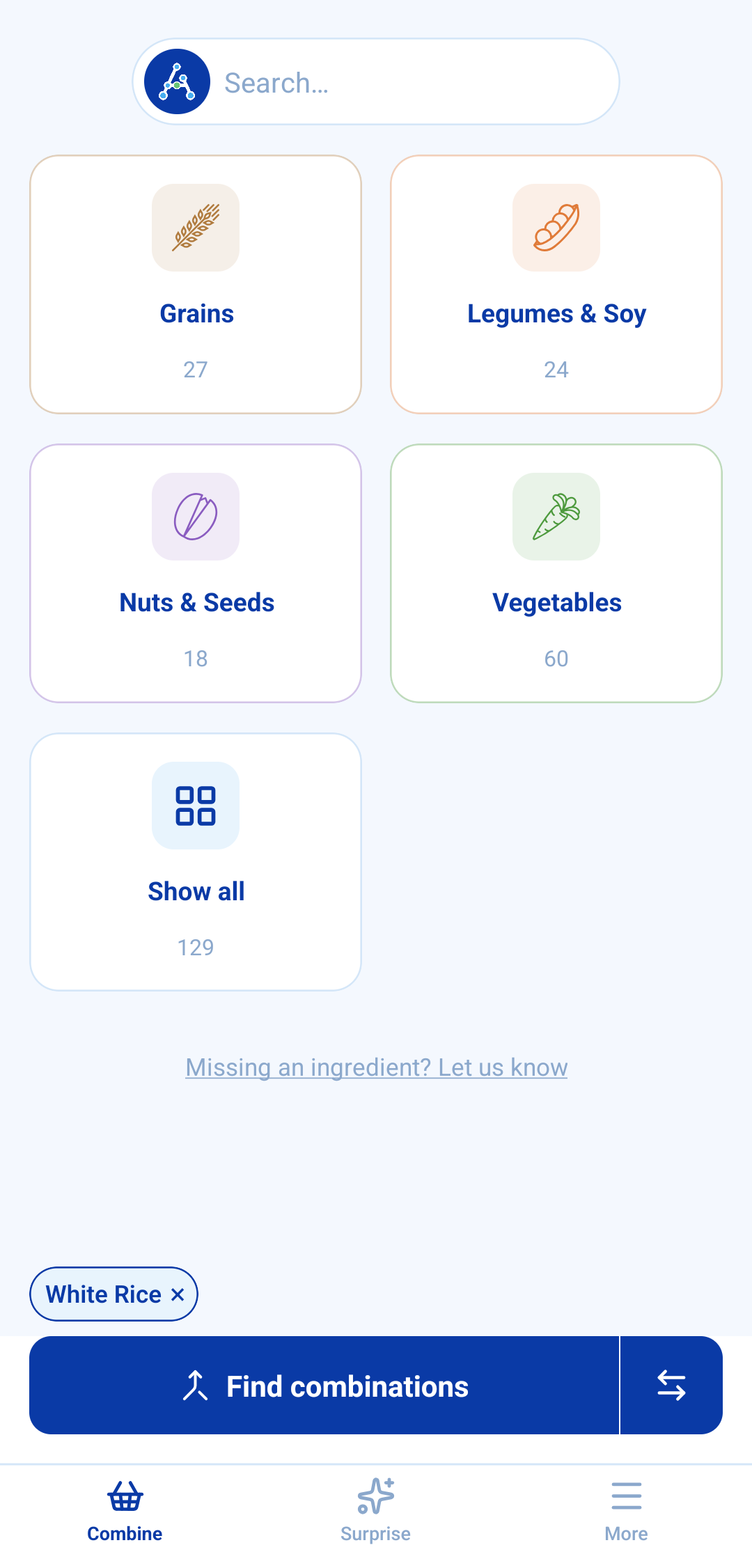
Pick what you have
Choose one or more foods from 200+ ingredients — grains, legumes, nuts and seeds, vegetables, and animal products if you eat them. Dietary filters for vegan, vegetarian or anything you avoid apply everywhere at once.
Let it search
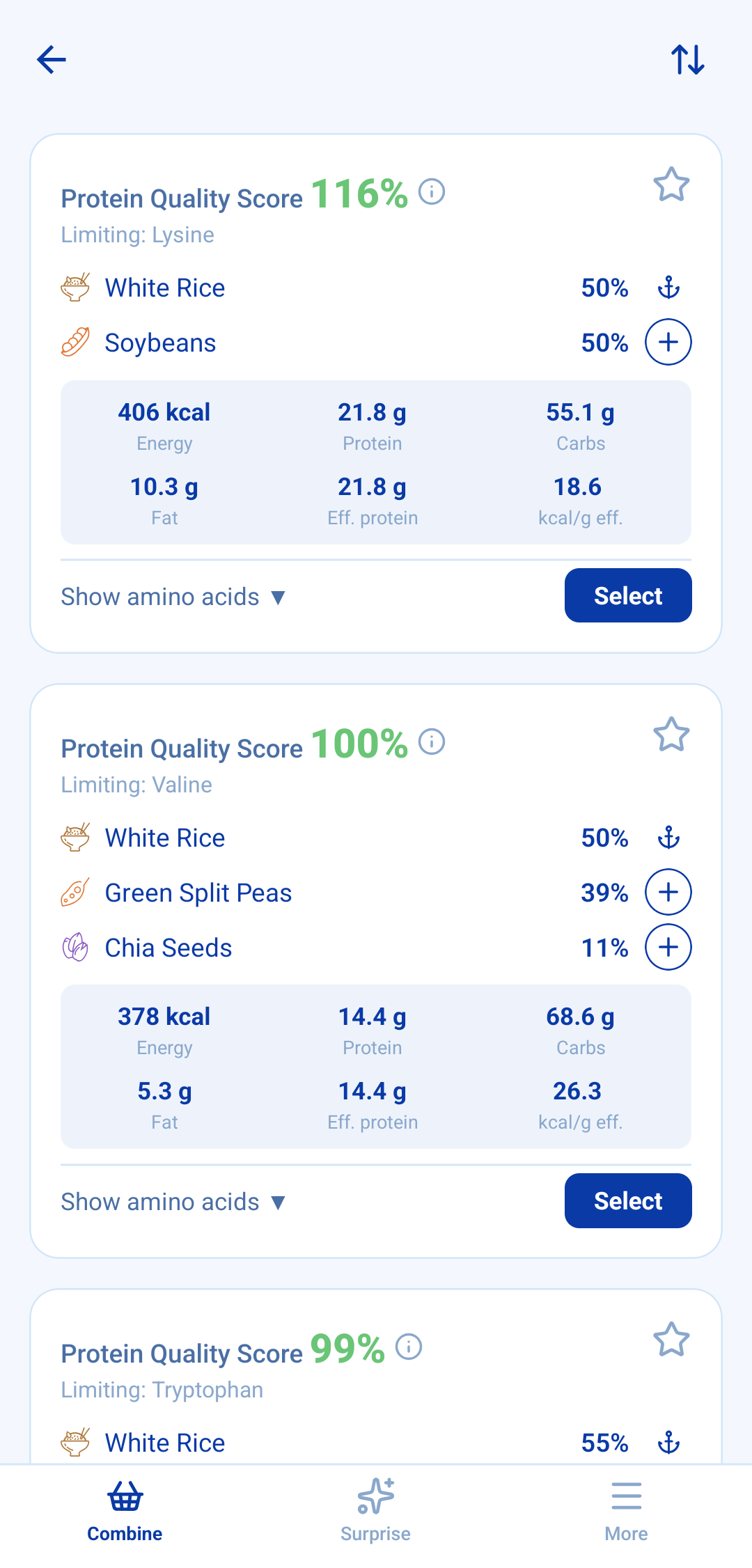
The optimizer finds the partners that fill your selection's gaps, and solves for the proportions that push the weakest essential amino acid as high as it will go. Or keep your selection fixed and only optimize the ratios between those foods.
Cook it your way
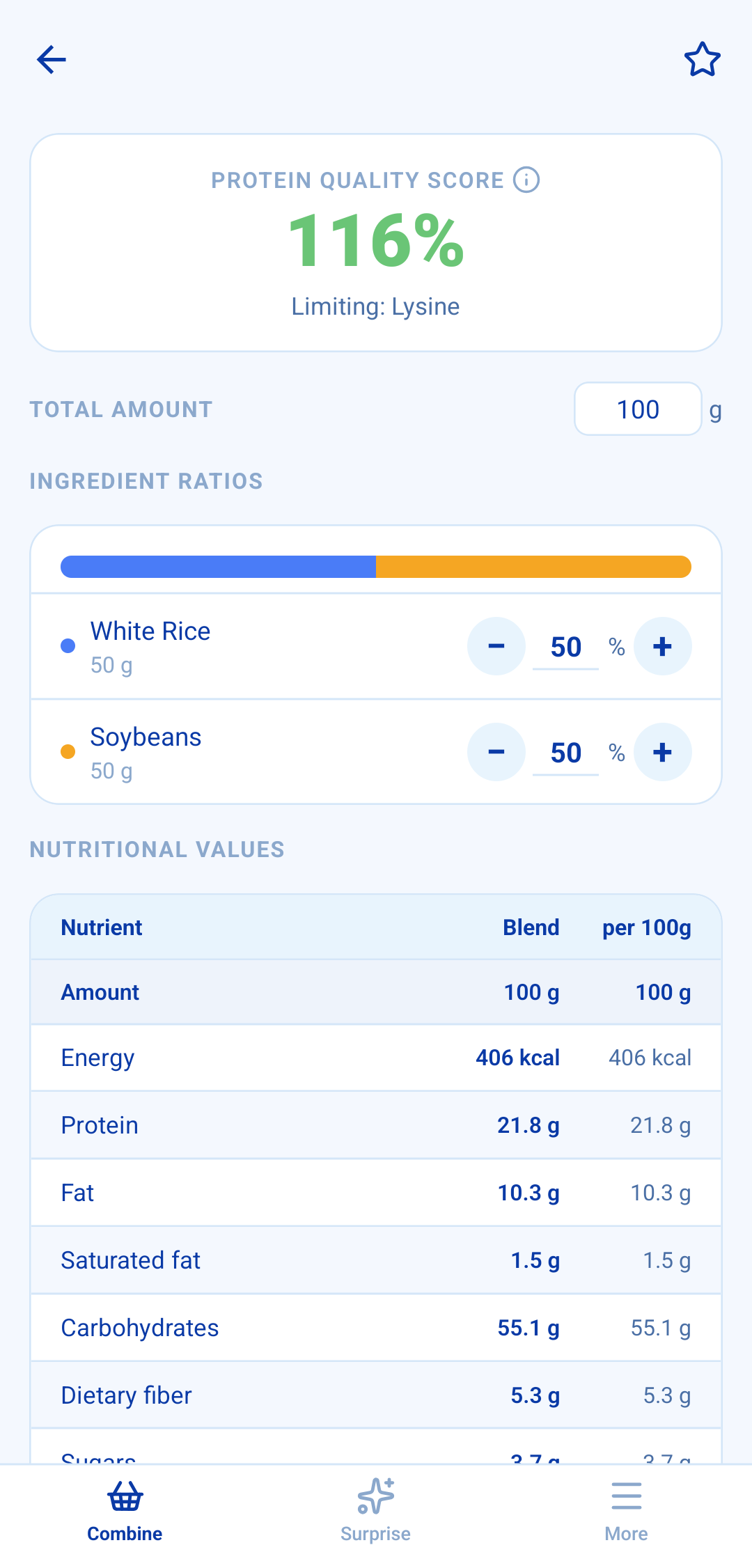
Every combination comes with a Protein Quality Score, the limiting amino acid, calories, protein and full nutrition. Drag the ratios and everything recalculates live, so you always see the nutrition of your own mix.
03Who it is for
Whatever you eat
The nine essential amino acids are not a vegan problem, they are a human one. You will get the most out of this if you eat plant-based, or if you train — that is where the gaps are widest and where you are probably counting already.
If you eat plant-based
Every plant protein is short somewhere, so covering all nine EAAs is a question of what you combine, not how much you eat. Do it by feel and you either waste protein or eat more than you need to.
AminoAce tells you which foods to pair, in what ratio, and what the result scores. Eat dairy or eggs? Switch them on and they join the search.
If you train
You already count protein. Amino acid balance is the part the label does not tell you: 30 g of protein short on lysine does not build 30 g worth of anything.
And once the balance is right, you still decide what the ratios optimize for — and can sort any list on the number you actually care about, effective protein included. The goals are below.
04Your goal
Reaching 100% is where the choice starts
Once all nine amino acids are covered there is usually still room in the exact ratios. What that room is spent on is your call — the app asks when you first open it, and it is one tap away in settings afterwards.
Calorie efficiency
The fewest calories per gram of usable protein. Two combinations can both reach 100% while one of them costs you half the calories — this is the end of the dial you want when you are cutting.
Protein amount
The most protein per 100 g of food, for when the limit is how much you can eat rather than how many calories you can spend. The same dial, turned the other way, for bulking.
Max quality
Push every amino acid past its target instead of just reaching it. The surplus is not wasted: your body pools amino acids across the day, so it can cover a weaker meal later.
Or sort by your own metric
Whichever goal you set, every list of results can be re-sorted — up to four criteria deep. Effective protein is the one worth knowing about: protein adjusted for quality, which is the number that answers whether something is actually a good protein source rather than merely a complete one. Also calories per gram of effective protein, calories per gram of protein, raw protein, the quality score itself, the number of ingredients, or any single one of the nine amino acids.
All of it works on usable protein rather than the number on the label: 30 g of protein that is short on lysine does not count as 30 g.
05Real combinations
Vegan protein combinations, and what they actually score
Rice and beans is the classic pairing. It is also not something you want on the plate every day — so here is what else works. Every figure is what the app returns, with the ratios it worked out; the screenshots are those exact results.
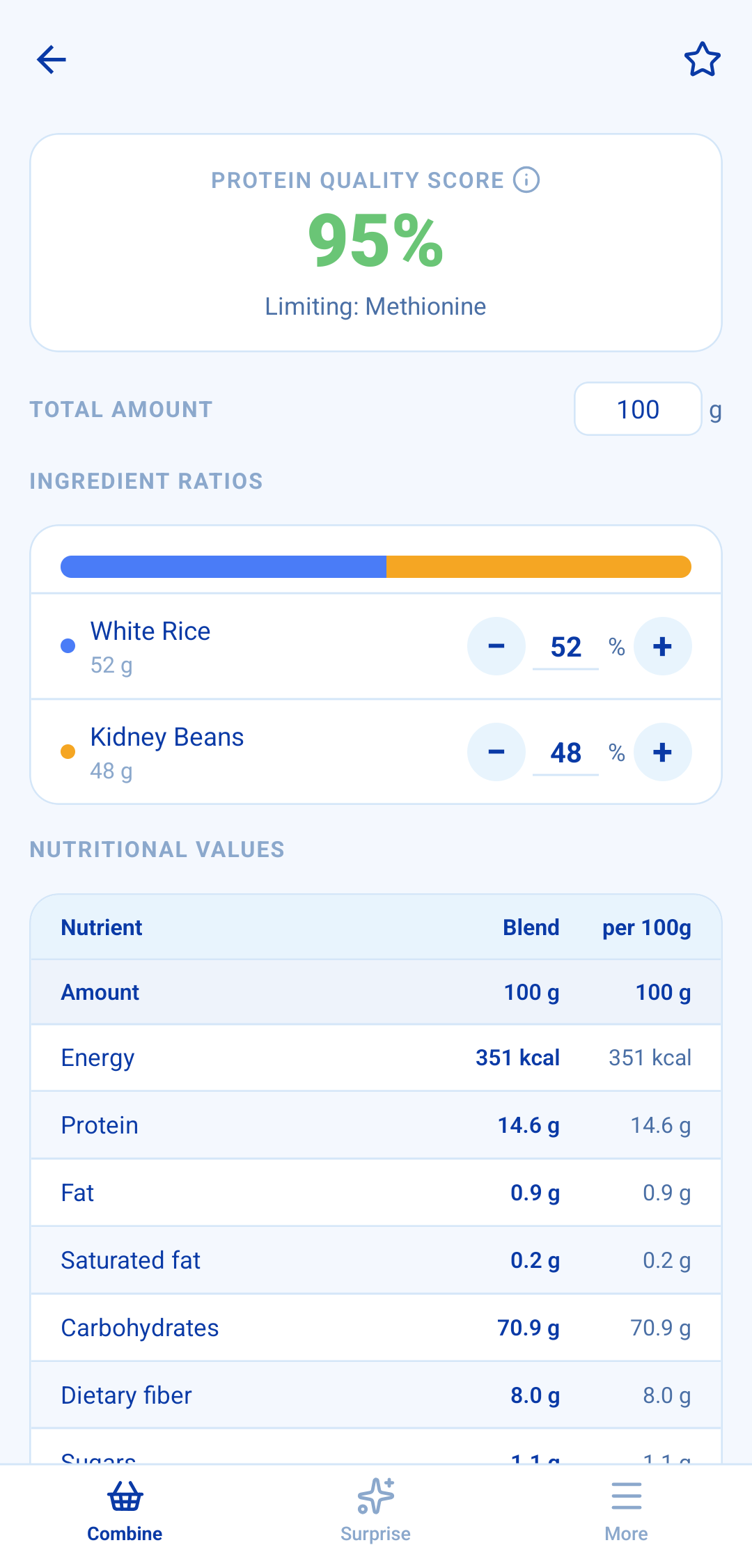
White Rice 52% · Kidney Beans 48%
Near enough a 1:1 mix. Rice covers the beans' methionine gap, the beans cover the rice's lysine gap — and it still stops short of 100%. The five below show what else the app finds, and what each one scores.
Nutrition & score
95%protein quality
- 14.6 gprotein
- 351 kcalenergy
- 25.4kcal / g usable
- 0.9 gfat
- 70.9 gcarbs
- 8.0 gfibre
per 100 g
Name one ingredient — it finds what completes it
You pick what is in your cupboard, the app searches for the partners that fill its gaps and works out the ratio. These five came out of it exactly the way yours will.
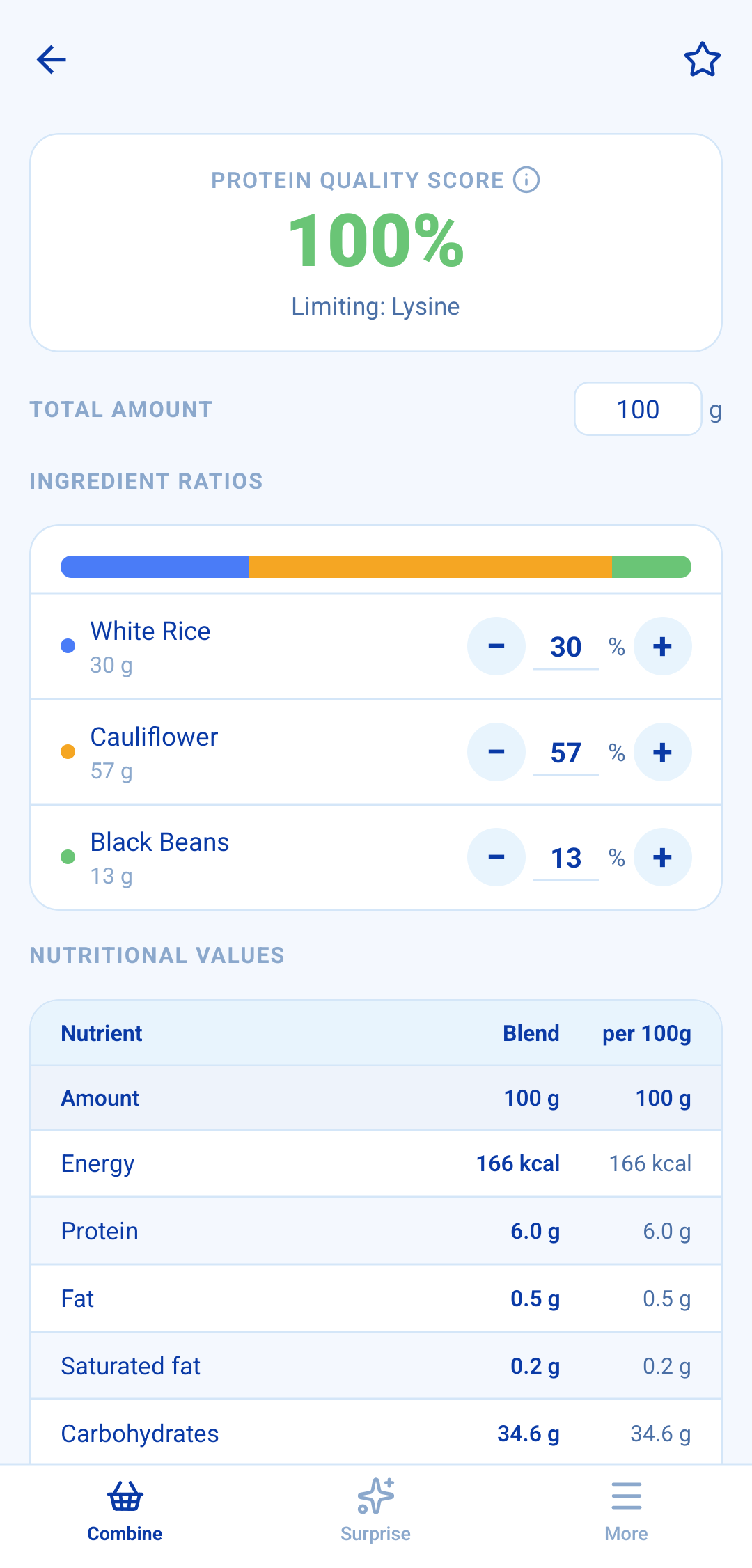
White Rice 30% · Cauliflower 57% · Black Beans 13%
A cauliflower-rice bowl — light, and complete.
Nutrition & score
100%protein quality
- 6.0 gprotein
- 166 kcalenergy
- 27.9kcal / g usable
- 0.5 gfat
- 34.6 gcarbs
- 3.5 gfibre
per 100 g
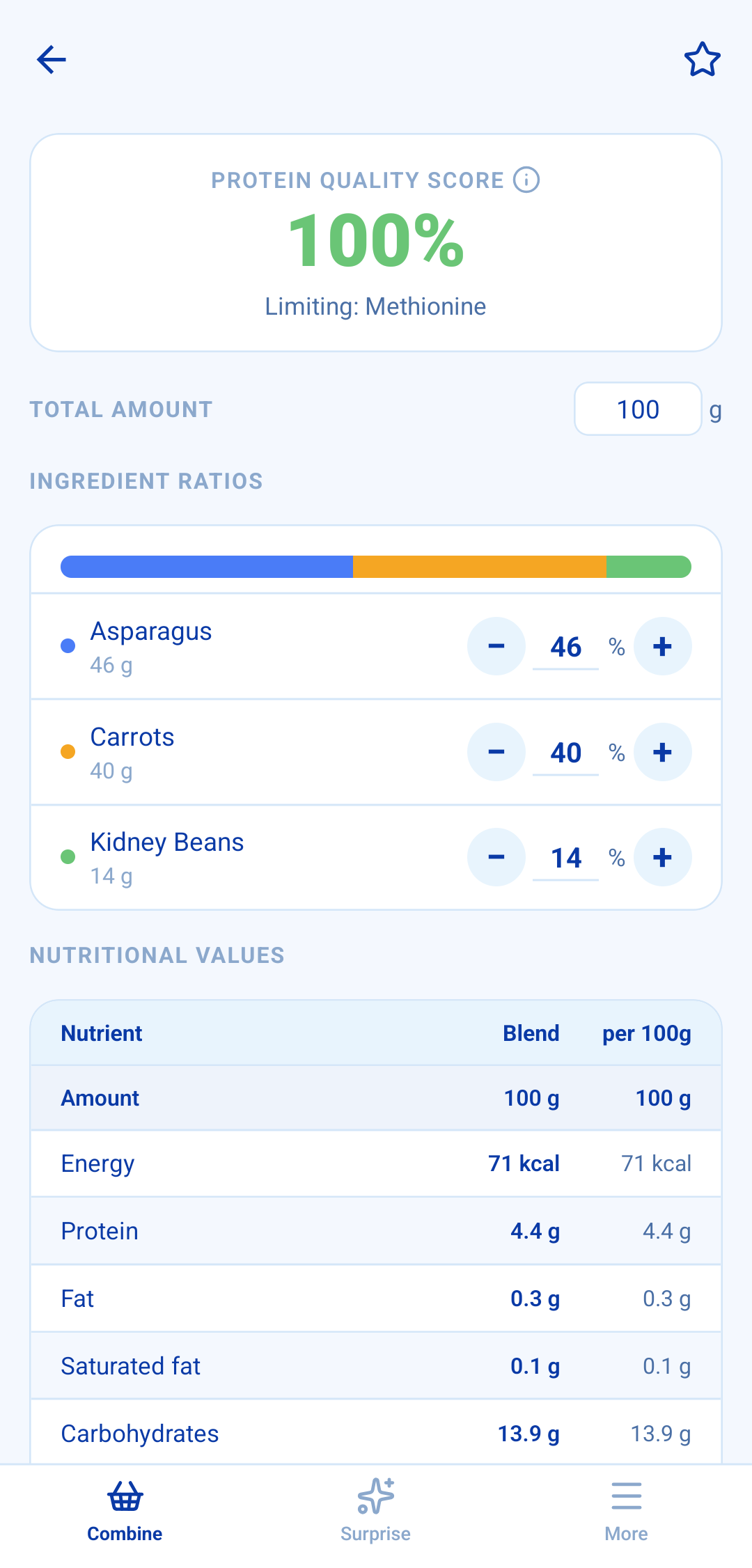
Asparagus 46% · Carrots 40% · Kidney Beans 14%
A vegetable side that quietly covers all nine.
Nutrition & score
100%protein quality
- 4.4 gprotein
- 71 kcalenergy
- 16.1kcal / g usable
- 0.3 gfat
- 13.9 gcarbs
- 4.2 gfibre
per 100 g
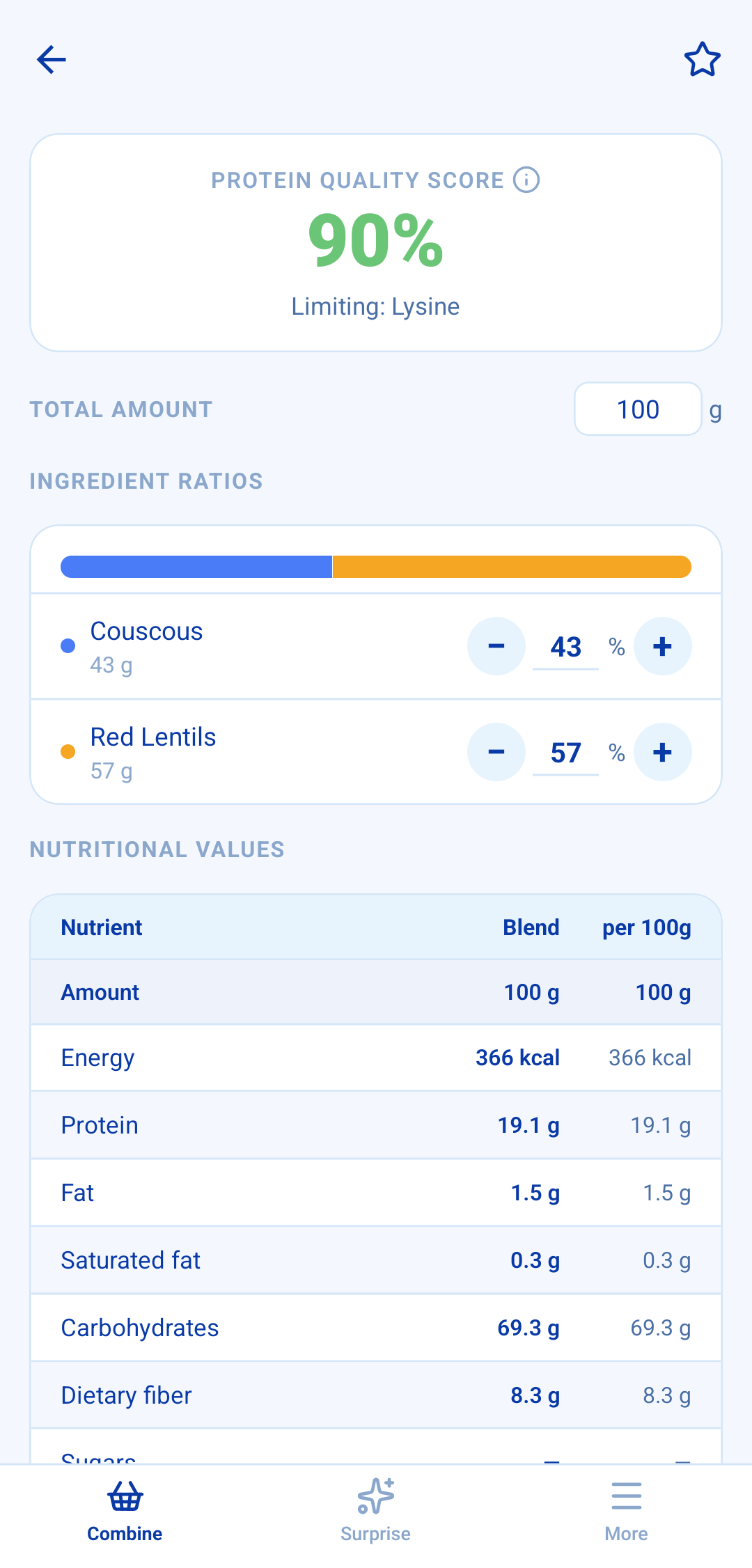
Couscous 43% · Red Lentils 57%
A proper main, and the most protein-dense pair here.
Nutrition & score
90%protein quality
- 19.1 gprotein
- 366 kcalenergy
- 21.2kcal / g usable
- 1.5 gfat
- 69.3 gcarbs
- 8.3 gfibre
per 100 g
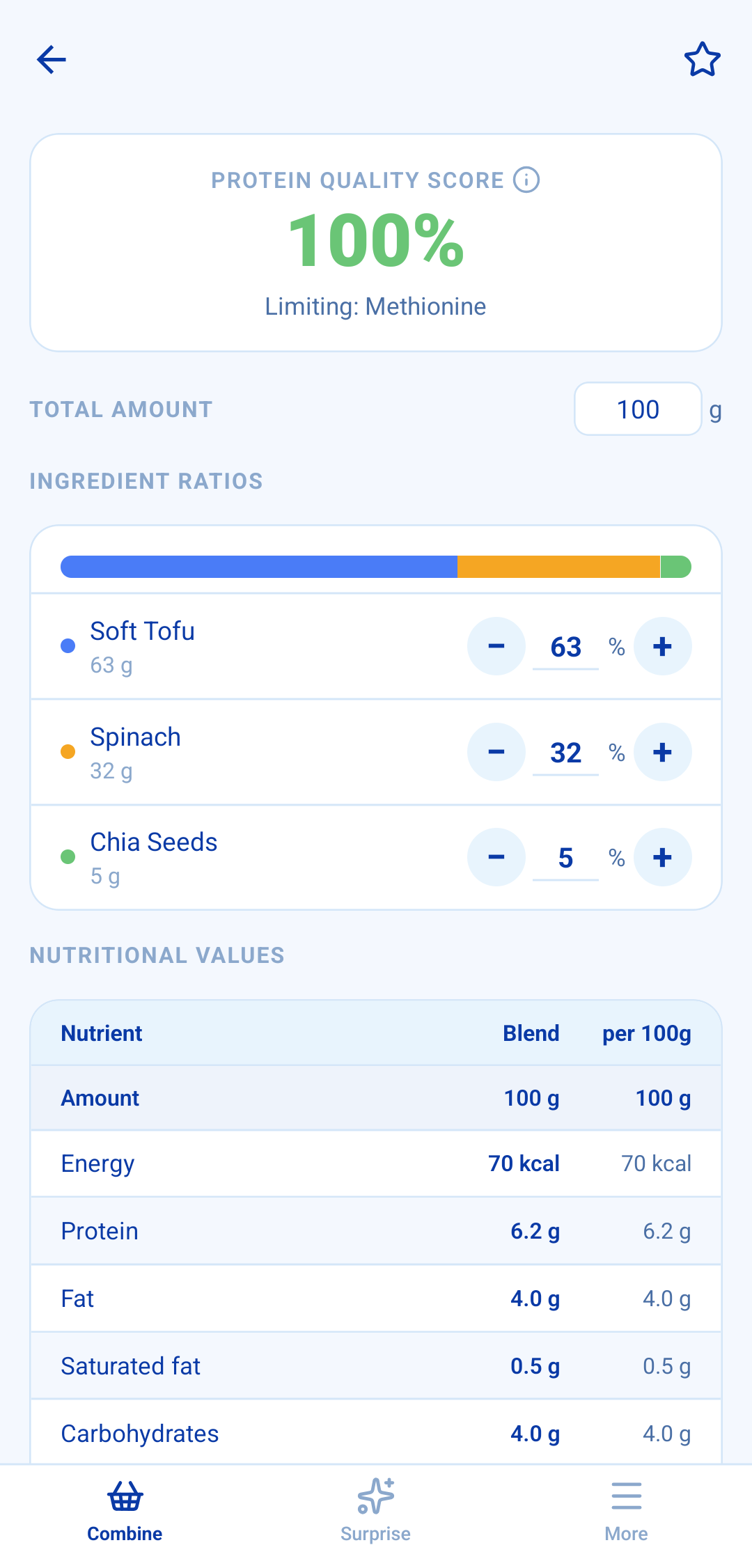
Soft Tofu 63% · Spinach 32% · Chia Seeds 5%
The most calorie-efficient of the lot, by a distance.
Nutrition & score
100%protein quality
- 6.2 gprotein
- 70 kcalenergy
- 11.3kcal / g usable
- 4.0 gfat
- 4.0 gcarbs
- 2.5 gfibre
per 100 g
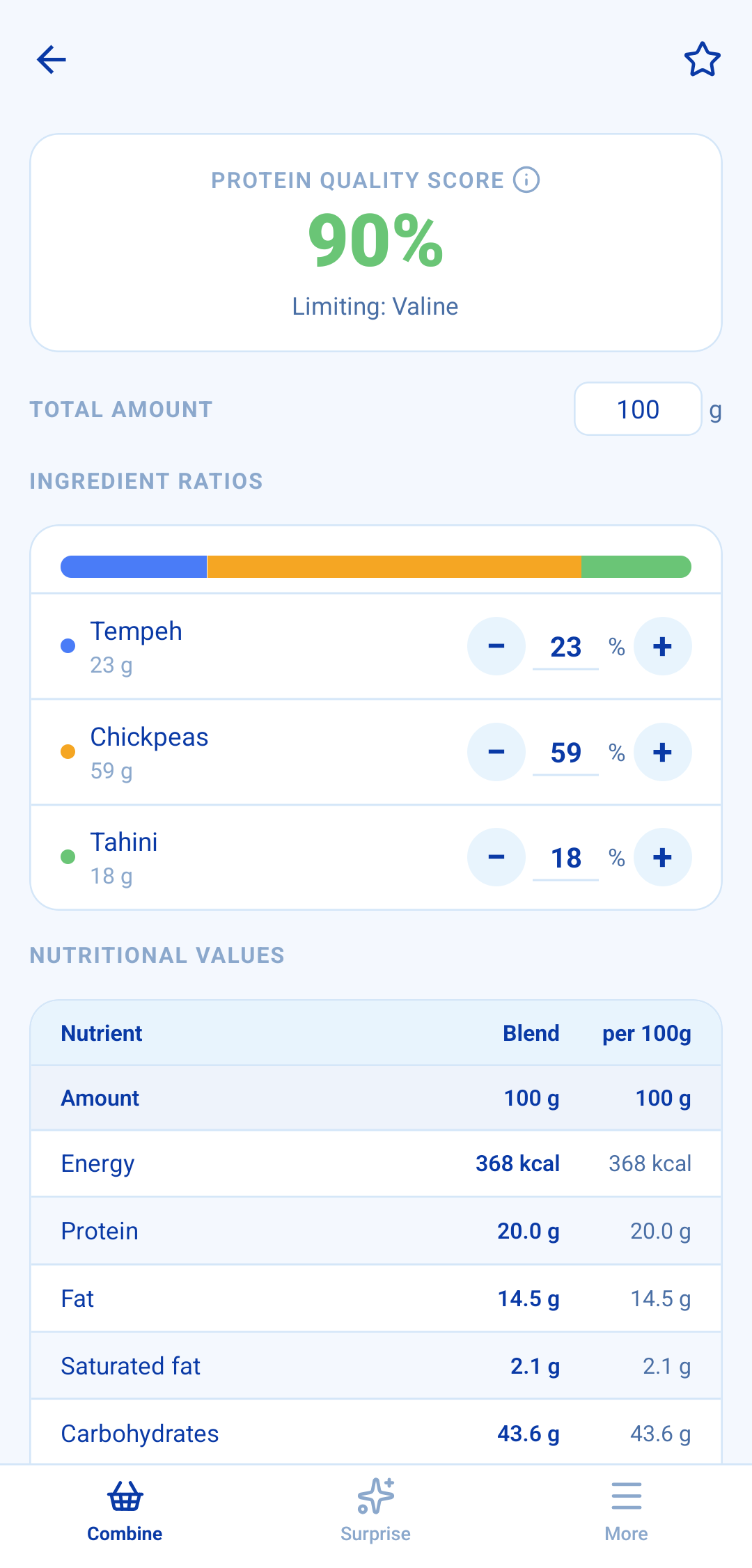
Chickpeas 59% · Tempeh 23% · Tahini 18%
Most protein here — a bowl with tahini over it.
Nutrition & score
90%protein quality
- 20.0 gprotein
- 368 kcalenergy
- 20.4kcal / g usable
- 14.5 gfat
- 43.6 gcarbs
- 8.9 gfibre
per 100 g
And millions more
Pick what is in your cupboard and the app searches 200+ ingredients for the partners that fill your gaps — filtered to what you actually eat.
Ratios are weight shares of raw ingredients, solved for calorie efficiency; "usable" protein is the digestibility-adjusted figure explained below. A combination that clears 100% is capped there — the surplus goes into calorie efficiency rather than a higher number — so a light vegetable dish and a dense grain-and-legume bowl can both read 100% and still differ enormously in protein. Both columns are shown for exactly that reason.
06The method
How the score is calculated
Each of the nine essential amino acids in a combination is compared with how much of it your body needs. The Protein Quality Score is simply the lowest of those nine ratios — a digestibility-adjusted measure in the tradition of PDCAAS. A score above 100% means every EAA clears its target, and the surplus is not wasted: your body pools amino acids across the whole day.
Amino acid values come from the USDA food database. Because your body usually cannot absorb everything you eat, those values are adjusted with standard digestibility figures per food category, drawn from public research.* The score is a solid estimate of what reaches your body, not an exact measurement of it.
Variety beats perfection
Your body pools amino acids over a full day rather than a single meal. A varied spread of complementary plant proteins across your meals delivers more complete nutrition than perfecting the ratio of any one combination.
Which is why the app is built for browsing combinations, not for prescribing a diet.
* Digestibility figures based on FAO Food & Nutrition Paper 92 (2013) and Herreman et al. (2020), Food Science & Nutrition.
07Questions
Frequently asked questions
Why do I need an amino acid app at all?
Protein is made of nine essential amino acids your body cannot produce itself. If a meal is short on even one of them, the rest of that protein cannot be fully used. Almost every single food is short somewhere — rice on lysine, beans on methionine. AminoAce searches hundreds of foods for combinations that cover each other's gaps, and works out the ratio that covers them best.
Do vegans really need to combine proteins at every meal?
No — and the app does not claim otherwise. Your body pools amino acids over a full day, so variety across your meals matters more than perfecting any single plate. Combining is worth doing because it raises how much of the protein you eat is usable, not because a meal eaten "wrong" is lost.
Which foods are included?
200+ whole ingredients with USDA amino acid data: grains, legumes and soy, nuts and seeds, vegetables, and — if you eat them — meat, fish, dairy and eggs. There is no fruit: almost all fruit contains too little protein to change a combination.
Does it work if I am vegetarian, or eat meat?
Yes. Set vegan, vegetarian, or pick individual things you avoid, and every filter applies everywhere in the app at once. Combining simply matters less the more animal protein you eat, because those proteins are closer to complete on their own — which is why the app is built with plant-based eating in mind.
Are the amounts raw or cooked?
Raw. All values come from the USDA database for raw, uncooked ingredients. Cooking mainly changes the water content, so weigh your ingredients before cooking if you want to match the amounts shown.
Does it cost anything, and do I need an account?
It is free and there is no account, no sign-in and no profile. Your dietary preferences stay on your device. The app is supported by advertising; what the ad and analytics providers collect is set out in the privacy policy.
Can I optimize for something other than the score?
Covering all nine amino acids is always the first goal, but once a combination gets there the exact ratios usually still have some give. You choose what happens with it — calorie efficiency, protein amount or maximum quality — when you first open the app, and you can change it in settings whenever you like. Separately, any list of results can be sorted on the number you care about, including effective protein, which is protein adjusted for quality.
